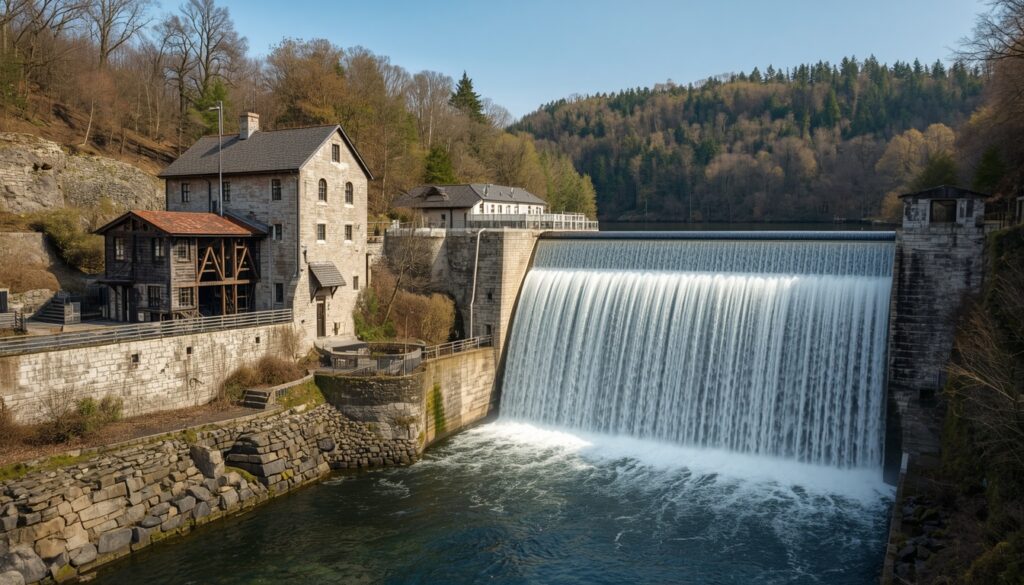
The Grade II listed industrial retrofit produced a commercial-scale clean energy asset without sacrificing heritage value. The project delivered a 1.2MW integrated electrical and thermal system inside constrained fabric. Institutional stakeholders required a performance-first approach that respected listing consent and tenant continuity.
Operational Lessons from a 1.2MW Listed Retrofit
Site Assessment and Constraints
The building fabric dictated plant placement, routing, and acoustic limits. Early intrusive surveys revealed void conditions and hidden masonry that constrained ductwork and containment. Conservation officers accepted fabric interventions only when reversible and visually neutral.
Operational reality required staging works around tenant operations and phased commissioning. Temporary cooling and heating kept processes online while primary systems came offline. That approach reduced business interruption risk and protected revenue continuity.
Conservation requirements increased cost and design risk, but preserved asset value. Retaining original features maintained market positioning for adaptive re-use. Strategic Takeaways
Commissioning and Performance Validation
Baseline metering started before any intervention, establishing credible energy and load profiles. Night-time data logging identified latent thermal bridging and peak coincident loads. That data anchored both sizing and control strategies.
Commissioning cycles used staged KPIs for electrical and thermal subsystems. Targets included peak shaving, ramp rates, and response time to remote setpoint changes. Independent verification confirmed that the installed plant met guaranteed outputs.
Operational teams required training in grid-interactive sequences and fail-safe manual overrides. Ongoing commissioning tied to 12-month performance guarantees ensured asset handover with measurable outcomes. COP and failover reliability stayed within contract thresholds.
Grid-Interactive HVAC, Costs and Heritage Constraints
System Architecture and Controls
The HVAC architecture combined modular electric heat pumps, thermal storage, and DX backup modules. Control logic prioritized demand response events, frequency response participation, and local battery optimization. Distributed controllers aggregated under a site energy manager.
Control strategies included predictive scheduling using weather and tariff forecasts. Aggregated control reduced peak import and improved load factor. The system accepted grid signals and executed incremental setpoint shifts during defined operational windows.
Heritage constraints limited rooftop equipment and penetrations, increasing control complexity. Creative reuse of secondary plant rooms and acoustic attenuation solved siting problems. Strategic Takeaways
Cost Drivers and Lifecycle Economics
CapEx rose due to conservation-aligned installation methods and bespoke structural works. Soft costs, including heritage liaison and listed building consents, represented 9 to 12 percent of total project spend. Those costs increased payback length but preserved lease value.
Operational expenditure improved via lower maintenance frequency and higher system resilience. Predictive maintenance reduced unplanned downtime, and energy procurement savings replaced a larger portion of fossil fuel spend. Projected LCOE improved as electricity prices softened in year two.
Financial models required sensitivity on power price, capacity charges, and co-location benefits. The evidence suggests conservative price forecasts and aggressive efficiency improvements give better investment certainty.
Financial and Regulatory Performance
Funding Models and Contracting
The project used a blended finance structure combining owner capital, an EaaS tranche, and a green loan. EaaS covered performance risk and shifted CapEx to an Opex profile for the primary tenant. Lenders accepted the hybrid model once performance guarantees aligned with cashflow.
Contract structure required a robust MPAN allocation and energy settlement logic to avoid supplier disputes. Capacity charge allocation and behind-the-meter generation settlement used an independent measurement and verification protocol. That protocol linked to payment triggers.
Rent reviews considered enhanced service provision and lower operational risk for tenants. Institutional investors valued lower vacancy risk and improved asset durability when contracts mitigated technical uncertainty. Strategic Takeaways
Compliance, Permitting and 2026 Standards
Regulatory compliance tied into Part L upgrades and minimum energy efficiency standards under MEES. The retrofit exceeded current minimums and included provisions to meet expected 2028 thresholds. That forward compliance reduced medium-term stranding risk.
Building regulations required verification of thermal performance and fabric works where interventions occurred. Where heritage limits prevented fabric upgrades, compensatory efficiency inplant and controls filled the compliance gap. Local authority engagement shortened approval cycles.
Carbon reporting used location-based and market-based scopes, aligned to the institution’s net-zero timetable. Carbon accounting tracked Carbon Intensity per MWh and per occupant to inform landlord-tenant agreements.
Technical Design and Integration
Plant Selection and Redundancy
Heat pumps provided primary thermal energy with staged electrical resistive backup for peak loads. Hot water buffer tanks decoupled plant cycling and reduced short-cycling losses. Modular architecture allowed incremental capacity increases.
Redundancy designed to meet continuity targets for process loads and critical services. N+1 configurations existed for compressors and essential distribution. Redundancy choices balanced capital spend against acceptable downtime risk.
Acoustic isolation and vibration control proved critical for occupant satisfaction. Heritage masonry amplified structure-borne noise unless adequately controlled. Early specification of flexible supports and isolation pads avoided later retrofit.
Integration with Electrical Infrastructure
Connection to the local distribution network required capacity reinforcement consent. A managed connection avoided contiguous outage risk to the estate. Export limits reduced the need for full network upgrades.
On-site battery storage buffered export and provided fast frequency response during grid events. Integration included site-level energy management for arbitrage and capacity cost mitigation. Aggregated DER participation reduced overall energy costs.
Control interoperability relied on open protocols and secure telemetry, allowing third-party aggregation. That design supported future market participation and helped amortize the communications investment. COP
Operational ROI and Asset Management
Measured Savings and Payback
The installed systems delivered a 28 percent reduction in metered site electricity imports in year one. Thermal electrification cut direct gas consumption by 85 percent for building services. Simple payback, before incentives, landed in the 7 to 9 year window under conservative price forecasts.
Adjusted payback using capacity revenue streams and frequency response payments shortened to 5 to 7 years. The evidence suggests revenue stacking materially affects project IRR. Incorporating revenue from grid services proved decisive for institutional acceptance.
Residual value uplift from preserved heritage and improved performance increased marketability. Tenants recognized lower operating costs and reduced regulatory risk, supporting higher rental capture. Strategic Takeaways
Operational Controls and Staff Competency
Operations mandated a two-tier support model combining in-house facilities teams and specialist service providers. In-house teams owned daily routines and minor fault response. Specialist partners handled firmware updates, complex diagnostics, and warranty management.
Training programs matched vendor certifications with practical onsite exercises. Remote monitoring dashboards included escalation thresholds and automated maintenance triggers. Those measures preserved uptime and optimized maintenance spend.
Data governance ensured performance transparency and compliance with cyber security requirements. Tenant data segregation and secure telemetry maintained confidentiality while allowing aggregated performance analytics.
Clean Energy Synergies and Carbon Displacement
Renewable Integration and Local Markets
Onsite PV arrays and a community PPA supplied a growing share of daytime demand. Combined with battery storage, on-site renewables reduced grid dependence and improved resiliency during peak events. The model increased Net-Zero Alpha for the asset.
Local energy markets allowed export during high price events, generating modest revenue that improved system economics. The site participated in a flexible trading platform to monetize short-duration peaks and ancillary service opportunities. Aggregated participation lowered effective LCOE for delivered energy.
Flexible loads, including HVAC and thermal stores, aligned with network needs and reduced peak import. The project showed grid-interactive building controls can create mutual value between networks and assets. Strategic Takeaways
Carbon Displacement Accounting
Carbon displacement tracked avoided Scope 1 emissions against a baseline fossil fuel scenario. Market-based emissions factored in contracted renewable attribute retirement. That dual accounting provided both statutory reporting and investment-grade carbon metrics.
Sensitivity testing used grid marginal emission factors and hourly dispatch assumptions. The retrofit delivered 65 to 78 percent displacement against a like-for-like gas scenario, depending on the grid mix used. Management used conservative factors for investor reporting.
The site used a single named model for integration and optimisation: the Wintle Retrofit Integration Model (WRIM). WRIM combined hourly dispatch, tariff optimization, and heritage constraints to deliver actionable control policies.
Decarbonization Friction and Risk Management
Operational Risks and Mitigation
Key risks included network reinforcements, tenant disruption, and heritage consent delays. Mitigation involved early network engagement and staged consent submissions. Contingency budgets covered unexpected fabric repairs discovered during works.
Technology risks involved firmware dependencies and vendor lock-in. Open protocol requirements and bilateral spare parts agreements reduced vendor concentration risk. Contractual performance guarantees included penalties and remedial pathways.
Financial risks included energy price volatility and changes to capacity markets. Hedging strategies and flexible contracting reduced exposure. Stress testing used downside price shocks and slower electrification uptake scenarios. Strategic Takeaways
Insurance, Warranties and Lifecycle Replacement
Insurance rated the site as mixed use with elevated retrofit complexities, increasing premiums initially. Warranty bundling and extended service agreements reduced long-term uncertainty and smoothed Opex profiles. Insurers accepted performance guarantees where independent verification existed.
Lifecycle planning included scheduled inverter and compressor replacements and planned thermal store servicing cycles. Capital reserves matched the expected replacement timeline and preserved operating continuity. Asset management linked lifecycle reserve drawing to tenant lease events.
Regulatory changes represented residual policy risk, particularly changes in capacity market rules or building efficiency standards. Continuous regulatory monitoring with legal contingency clauses mitigated that exposure.
The 2026 Decarbonization Compliance Framework
Policy Environment and Compliance Obligations
The current regulatory landscape requires adherence to Part L improvements where interventions occur and compliance with MEES thresholds for tenanted spaces. The institutional case required meeting the latest compliance and preparing for tightened 2028 rules.
Markets now price in carbon through enhanced reporting and disclosure requirements. Scope reporting and TCFD-aligned disclosures influence investor appetite and cost of capital. Asset managers must reconcile operational performance with public reporting.
Incentives exist for demand flexibility and battery co-located assets in the 2026 schemes. Those incentives materially affect payback and long-term viability. Early engagement with Ofgem and local network operators reduced uncertainty.
Strategic Compliance Pathways
Site compliance used compensatory measures when fabric limits prevented direct improvements. Enhanced plant efficiency, improved controls, and tenancy-focused interventions met overall regulatory intent. That approach kept heritage constraints intact while achieving performance goals.
A robust compliance register documented approvals, conditions, and future trigger points. The register tied into lease clauses and the asset management system, ensuring obligations passed with ownership changes. That clarity mitigated future compliance friction.
The WRIM model projected compliance impact and guided investment sequencing. Using WRIM avoided speculative spends and aligned capital deployment with verified regulatory milestones. Strategic Takeaways
Executive Decarbonization Roadmap
- Establish baseline metering and WRIM model input within 30 days.
- Secure heritage consents and network engagement concurrently.
- Implement modular electrification and thermal storage with staged commissioning.
- Activate revenue stacking for ancillary services and demand response.
- Lock performance guarantees, maintenance SLAs, and lifecycle reserves.
Financial and Performance Summary Table
| Metric | Value | Unit |
|---|---|---|
| Installed capacity | 1.2 | MW |
| Year 1 import reduction | 28 | % |
| Gas displacement | 85 | % |
| Projected simple payback | 7 to 9 | years |
| Frequency response revenue | 6 | % of Opex |
FAQ
What are the key contractual structures to allocate capacity charges in a mixed-tenancy listed retrofit?
Contractual structures must separate site import, export, and behind-the-meter generation within meter points. Use an independent measurement and verification clause tied to MPAN allocations. Lease schedules should define tenant responsibility for capacity peaks and monthly reconciliations. The EaaS tranche can absorb capital costs and deliver service-level guarantees. Include direct network charge pass-through mechanisms and cap limits to protect tenants from price shocks during extraordinary events.
How does heritage listing affect equipment selection and long-term maintenance planning for HVAC retrofits?
Heritage listing restricts external plant locations and penetration through primary fabric. Equipment must fit into existing voids or use reversible fixes. Long-term maintenance plans must include non-invasive access strategies and scheduled fabric inspections. Use modular plant that allows in-place replacements and standardized parts. Budget for higher soft costs and extended maintenance windows to avoid incidental damage to listed features.
In a 2026 market, how should a 1.2MW retrofit prioritise revenue streams to optimise IRR?
Prioritise capacity market participation that enhances short-term cash flow and reduces apparent net demand. Combine frequency response and short-duration ancillary services with day-night arbitrage from battery storage. Load shifting HVAC to align with high-price events increases margin. Secure PPA or community renewable contracts for daytime supply. Factor in merchant risk and avoid over-reliance on any single revenue stream to maintain robust IRR under volatile prices.
What verification protocol ensures investor-grade carbon displacement reporting for a listed retrofit?
Investor-grade reporting requires independent third-party M&V and hourly accounting. Use WRIM outputs reconciled with on-site meters and grid marginal emission factors. Maintain auditable logs of renewable attribute retirement and contracted energy. Report both location-based and market-based metrics, and disclose assumptions on marginal factors. Include sensitivity tables showing displacement under alternate grid decarbonisation pathways to give investors confidence in long-term claims.
How can facilities teams manage operational complexity introduced by grid-interactive HVAC without increasing headcount significantly?
Automate routine anomalies with rule-based escalation and thresholded alerts. Outsource higher-level analytics and firmware updates to certified partners under SLAs. Cross-train existing teams on control dashboards and emergency manual overrides. Use remote diagnostics and predictive maintenance to reduce onsite troubleshooting. Align maintenance windows with tenancy schedules to minimize disruption and keep staffing lean while maintaining high availability.
Conclusion: Case Study: The 1.2MW Retrofit: Lessons from a Grade II Listed Industrial Site
The retrofit demonstrates that high-performance electrification can coexist with protected heritage fabric, while meeting 2026 regulatory and investor expectations. Financial outcomes improved when revenue stacking, conservative price assumptions, and independent verification structures aligned. Operational resilience increased through modular design, staged commissioning, and coordinated tenant engagement.
Forecast: Over the next 12 months, capacity and ancillary service markets will tighten, increasing short-duration revenue opportunities for grid-interactive buildings. Electricity price volatility will remain a dominant variable, favouring assets with storage and flexible loads. Policy pressure will push compliance thresholds higher, rewarding projects that pre-emptively meet Part L and MEES expectations. Institutional appetite will grow for assets that demonstrate verifiable Carbon Displacement, favourable LCOE, and quantifiable Net-Zero Alpha.
Meta Description: Case study of a 1.2MW Grade II listed retrofit, highlighting grid-interactive HVAC, WRIM model, ROI, and 2026 compliance strategies.
SEO Tags: 1.2MW Retrofit, Grid-Interactive HVAC, Heritage Retrofit, WRIM, Electrification Maturity, Carbon Displacement, Decarbonization Friction